Under Glass
Summary
The Domain Wintergardens combine New Zealand’s natural and cultural heritage, consisting of structures displaying a variety of native and exotic flora in the Auckland Domain. They were originally started during the First World War to commemorate the success of the Industrial, Agricultural and Mining Exhibition of 1913-1914, held on the same site. Profits from the exhibition were used to create sports fields, and to erect a Temperate – or Cool – House in 1916-1921 for the year-round display of flowering plants. Other parts of the Wintergardens were planned at the same time, but not carried out until the late 1920s, when a Tropical House, Fernery and connecting courtyard were added. The gardens provided a focus for promenades in the winter months and were part of the gentrification of the park, which had earlier been seen as a haunt of ‘undesirables’. The Domain had been set aside as Crown land in 1841 and enshrined as a place of public recreation in 1844.
The structures were designed by William Henry Gummer and Charles Reginald Ford, who were among the leading architects of their day. The Temperate and Tropical houses are barrel-vaulted steel and glass structures, arranged symmetrically on either side of the complex. They are separated by the enclosed courtyard, while the Fernery occupies a more irregular grotto setting to the rear. The courtyard contains a number of statues, added in 1945, and a sunken pond that was modified in 1954. Each structure within the Wintergardens was designed to display different types of flora, the Temperate House having exotic potted plants and the Tropical House more permanent plantings, such as banana and ravanela (traveller’s palm). The fernery is notable for its display of New Zealand plants, some of which may have come from a collection that won the first Loder Cup in 1926. The cup was established by the New Zealand Institute of Horticulture to encourage the appreciation and cultivation of native flora.
The Domain Wintergardens are among the best-preserved examples of their kind in the country and are nationally significant for demonstrating early twentieth-century garden design. They demonstrate attitudes to the natural world at that time, including an interest in exotic flora ‘discovered’ during European colonial expansion. They are particularly important for reflecting changes in approach to flora during the 1920s, with a growing emphasis on New Zealand plants. The Wintergardens are also significant for their association with the Auckland Industrial, Agricultural and Mining Exhibition, and the role of public parks as places of education and recreation. They are important for showing the architectural versatility of Gummer and Ford, and the value placed on public buildings in the early twentieth century. They have connections with other historic structures in the park – including the nearby rotunda, tea kiosk and Auckland War Memorial Museum – and enjoy high public esteem as popular and much-visited buildings.
Construction Professionals
Fletcher Construction Company
Fletcher Construction Company was founded by Scottish-born James Fletcher (1886 – 1974), the son of a builder. Six months after his arrival in Dunedin in 1908, Fletcher formed a house-building partnership with Bert Morris. They soon moved into larger-scale construction work, building the St Kilda Town Hall (1911), and the main dormitory block and Ross Chapel at Knox College (1912). Fletcher’s brothers, William, Andrew and John joined the business in 1911, which then became known as Fletcher Brothers. A branch was opened in Invercargill.
While holidaying in Auckland in 1916, James tendered for the construction of the the Auckland City Markets. By 1919 the company, then known as Fletcher Construction, was firmly established in Auckland and Wellington. Notable landmarks constructed by the company during the Depression included the Auckland University College Arts Building (completed 1926); Landmark House (the former Auckland Electric Power Board Building, 1927); Auckland Civic Theatre (1929); the Chateau Tongariro (1929); and the Dominion Museum, Wellington (1934).
Prior to the election of the first Labour Government, Fletcher (a Reform supporter) had advised the Labour Party on housing policy as hbe believed in large-scale planning and in the inter-dependence of government and business. However, he declined an approach by Prime Minister Michael Joseph Savage in December 1935 to sell the company to the government, when the latter wanted to ensure the large-scale production of rental state housing. Although Fletchers ultimately went on to build many of New Zealand’s state houses, for several years Residential Construction Ltd (the subsidiary established to undertake their construction) sustained heavy financial losses.
Fletcher Construction became a public company, Fletcher Holdings, in 1940. Already Fletchers’ interests were wide ranging: brickyards, engineering shops, joinery factories, marble quarries, structural steel plants and other enterprises had been added the original construction firm. Further expansion could only be undertaken with outside capital.
During the Second World War James Fletcher, having retired as chairman of Fletcher Holdings, was seconded to the newly created position of Commissioner of State Construction which he held during 1942 and 1943. Directly responsible to Prime Minister Peter Fraser, Fletcher had almost complete control over the deployment of workers and resources. He also became the Commissioner of the Ministry of Works, set up in 1943, a position he held until December 1945.
In 1981 Fletcher Holdings; Tasman Pulp and Paper; and Challenge Corporation amalgamated to form Fletcher Challenge Ltd, at that time New Zealand’s largest company.
Williamson Construction Company – main contract
Gummer & Ford
The architectural partnership of Gummer and Ford was established in 1923, and became one of national importance.
William Henry Gummer (1884-1966) was articled to W.A. Holman, an Auckland architect, and was elected as an Associate of the Royal Institute of British Architects in 1910. In the period 1908-1913 he travelled in the United Kingdom, Europe and the United States. During this time he worked for Sir Edwin Lutyens, leading English architect of the time, and for Daniel Burnham in Chicago. Burnham was a major American architect and one of the founders of the influential Chicago School of Architecture. Gummer joined the firm of Hoggard and Prouse of Auckland and Wellington in 1913. In 1914 he was elected a Fellow of the New Zealand Institute of Architects, was president of the Institute from 1933-34 and was later elected a life member.
Charles Reginald Ford (1880- 1972) was born in England and served in the Royal Navy. He was later with Captain Scott’s 1901-1904 expedition to Antarctica. He trained as an architect working in Wanganui as an engineer. In 1926 he wrote the first treatise on earthquake and
building construction in the English language. Ford was president of the New Zealand Institute of Architects from 1921-22.
Buildings designed by the partnership include the State Insurance Building Wellington, (1940) the Dilworth Building (1926), the Guardian Trust Building and the Domain Wintergardens (1921 and 1928), all in Auckland, and the Dominion Museum (1936) in Wellington. Gummer and Ford were awarded Gold Medals from the New Zealand Institute of Architects for the designs of Auckland Railway Station and Remuera Library.
Gummer was one of the most outstanding architects working in New Zealand in the first half of this century and was responsible for the stylistically and structurally advanced Tauroa (1916), Craggy Range (1919), Arden (1926), and Te Mata (1935) homesteads at Havelock North.
Gummer, William Henry
Gummer (1884-1966) was articled to W.A. Holman, an Auckland architect, and qualified as an Associate of the Royal Institute of British Architects in 1910. From 1908 to 1913 he travelled in the United Kingdom, Europe and the United States. During this time he worked for Edwin Lutyens, a leading English architect of the time, and for Daniel Burnham in Chicago. Burnham was a major American architect and one of the founders of the influential Chicago School of Architecture.
Gummer joined the firm of Hoggard and Prouse of Auckland and Wellington in 1913. Significant commissions undertaken during this period included the New Zealand Insurance (later known as the Guardian Trust) Building, Auckland (1914-18).
In 1923 Gummer, one of the most outstanding architects working in New Zealand in the first half of the twentieth century, joined with Charles Reginald Ford (1880-1972) to create an architectural partnership of national significance. The practice was responsible for the design of the Dilworth Building (1926), Auckland, the Dominion Museum (1936) and the State Insurance Building (1940), both Wellington. Gummer and Ford were awarded Gold Medals by the New Zealand Institute of Architects for their designs of the Auckland Railway Station and Remuera Library.
Gummer was also responsible for the Bridge of Remembrance, Christchurch and the Cenotaph in Dunedin (1927), and the stylistically and structurally advanced Tauroa (1916), Craggy Range (1919), Arden (1926) and Te Mata (1935) homesteads at Havelock North. Elected a Fellow of the New Zealand Institute of Architects in 1914, he was president of the Institute from 1933-4 and was later elected a life member.
Frederick Wilson
No biography is currently available for this construction professional
Additional info
Physical Description
Architectural Description (Style):
The Domain Wintergardens’ dominant decorative impulse is found in its constructional elements; the lattice structure of the roof trusses, the circular window mullions; the roof lantern and the contrast of masonry buttresses with the intricacy of the steel structure.
Applied decoration had been kept to a minimum, being found in the detailed plaster plinths, window ledges and cornices. The only overt use of decoration as secondary elements is found in the scrolled caps on top of the brick piers and the scrolled reliefs on the bargeboards fronting the entrance porticos to each glass house.
The complex comprises two barrel vaulted steel and glass structures, supported on buttressed brick piers, separated along a secondary axis by an enclosed court featuring a sunken pool. The entrance follows the major symmetrical axis, which terminates in an informal grotto fernery. The complex overlooks the Domain Kiosk and duck ponds and the panorama of harbour and city.
The paved courtyard and pool with its accompanying Jarrah pergola colonnades binds the two vaulted structures into a single architectural composition.
Notable Features
Registration covers all structures within the Wintergarden complex, their fixtures and finishes. It also includes recent modifications. The structures lie on the site of a scoria quarry for the construction of Domain Drive, and the 1913-1914 Auckland Industrial, Agricultural and Mining Exhibition
Special Features: The various statues and ornaments occurring throughout the complex.
Construction Dates
Other
–
Site of scoria quarry
Other
1913 – 1914
Site of Auckland Industrial, Agricultural and Mining Exhibition
Original Construction
1916 – 1921
Construction of Temperate House
Original Construction
1927 – 1928
Construction of Tropical House, pergola and courtyard
Original Construction
1929 – 1930
Construction of Fernery
Addition
1945 –
Statues added
Modification
1954 –
Ornamental pool remodelled
Reconstruction
1993 – 1994
Fernery pergola rebuilt
Construction Details
Foundations: Brick piles with reinforced concrete footings.
Walls: 0.8 metre square buttressed brick piers, as compressive supports for 100mm x 250mm reinforced concrete lintels acting as ties for the roof structure. This enables an extensive amount of the wall area to be glazed.
Roof: Barrel vaulted structure comprised of series of steel lattice trusses. Trusses at 3.3m centres, span 1m are 450mm deep and fixed with 6mm rivets. (Working Drawings held by Hoadley Budge Olphert).
Completion Date
21st August 2001
Report Written By
Martin Jones
Information Sources
Auckland University
Auckland University
Sheppard Collection Library no. G50
Bush, 1971
G .W. A. Bush, ‘Decently and In Order: The Government of the City of Auckland 1840-1971’, Auckland, 1971
pp.116
New Zealand Building Progress
New Zealand Building Progress
Sept 1916, pp.729-30
New Zealand Herald
New Zealand Herald, 12 July 1932, p. 6; 28 September 1933, p. 6.
30 April 1994, p.2
Serials:
Aug 12 1916
Aug 26 1916
Apr 30 1928
Nov 30 1933
Feb 28 1945
Dec 14 1966
New Zealand Historic Places Trust (NZHPT)
New Zealand Historic Places Trust
‘The Domain Wintergardens, Domain Drive, Auckland Domain’, Buildings Classification Committee Report, Wellington, 1989 (held by NZHPT, Auckland)
New Zealand Institute of Architects Journal
New Zealand Institute of Architects Journal (NZIA)
Mar 20 1967, pp86-90
Pevsner, 1976
Nikolaus Pevsner, A History of Building Types, London, 1976
Fleming, 1980
John Fleming, Hugh Honour and N. Pevsner, Dictionary of Architecture, London, 1980
The Penguin Dictionary of Architecture, Third Edition, Harmondsworth 1980
Macmillian Encyclopedia of Architects, 1982
Macmillan Encyclopedia of Architects. The Free Press, New York, 1982
Kohlmaier, 1981
G Kohlmaier & B Von Sartory. Houses of Glass. A Nineteenth Century Building Type. MIT Press, Massachusetts, 1981
Auckland City Council
Auckland City Council
File No. 15/162 part one
APL, Nos 1916-60, 1927-270
Other Information
This historic place was registered under the Historic Places Act 1980. This report includes the text from the original Building Classification Committee report considered by the NZHPT Board at the time of registration.
Please note that entry on the New Zealand Heritage List/Rarangi Korero identifies only the heritage values of the property concerned, and should not be construed as advice on the state of the property, or as a comment of its soundness or safety, including in regard to earthquake risk, safety in the event of fire, or insanitary conditions.
The Winter Garden at the Auckland Domain is a treasure of great historic interest. It was designed in the early 1900s in the style of the famous English partnership of Edwin Lutyens and Gertrude Jeckyll and opened in 1913.
Rare and spectacular plants in an ever-changing display can be seen in each of the two barrel-vaulted Victorian style glass houses which face out on to an extensive court yard and sunken pool. The marble statues in the courtyard between the glass houses were added in the 1920s and 30s by local businessman William Elliot. One house is heated and shows off lush tropical and heat-loving plants while the other displays temperate plants changing with the seasons.
Substantial pergolas link the formal design and host many showy climbers. A wide collection of New Zealand ferns growing in a sunken scoria quarry to the rear completes the Winter Garden complex.

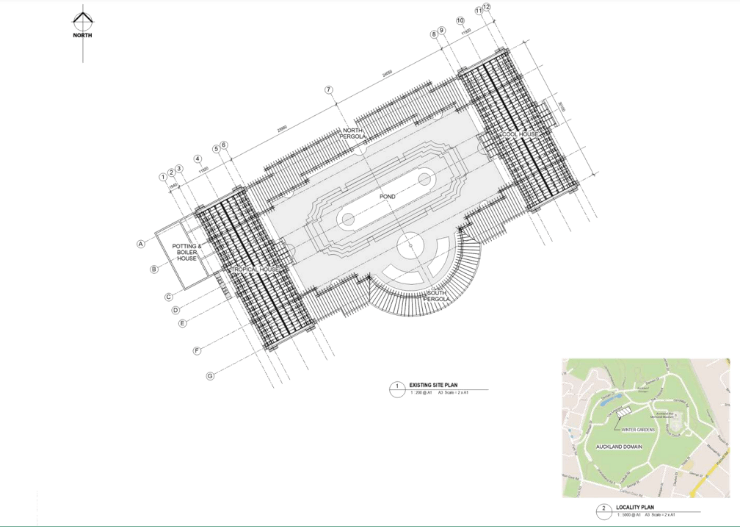

Winter Garden:
- Layout
- Architecture
- Charcteristics: Gardenesque & Arts and Craft
- Historical context/ evolution
- Botanic gardens
- Modification of environment
- Fernery and rockery
We are introduced to the paper guide for our very first third year project and are asked to proposed a scheme for a refurbishment or temporary retrofitting of the Auckland Domain Winter Gardens.
During World War II the domain was used as a camp ground by American troops
Winter Garden was designed in the early 1900s in the style of the famous English partnership of Edwin Lutyens and Gertrude Jeckyll.
Inside the glasshouse mosquitos live around the pond, there is a plant called Nepenthe pitcher plant it is a carnivorous and digests the insects by attracting them with its sap.


Volcano
Environmental – The domain is an extinct volcano (Pukekawa)
Pukekawa – hill of bitter memories
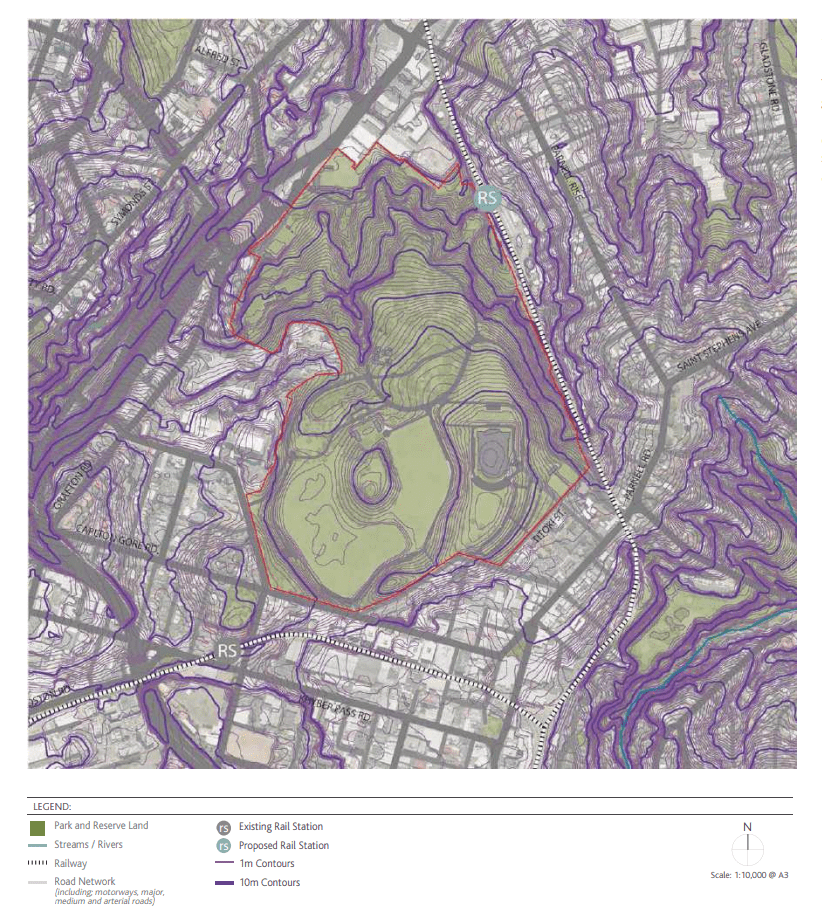
The Auckland Domain volcano, Pukekawa, is one of the oldest in the Auckland volcanic field, and consists of a large explosion crater surrounded by a tuff ring with a small scoria cone (Pukekaroro) in the centre of the crater. Its tuff ring, created by many explosive eruptions, is made of a mixture of volcanic ash, lapilli and fragmented sandstone country rock. Its eruption followed soon (in geological terms) after the neighbouring Grafton Volcano was created, destroying that volcano’s eastern parts and burying the rest.
Originally, the crater floor was filled with a lava lake, the western half collapsed slightly and became a freshwater lake which later turned into a swamp and slowly filled up with alluvium and sediment, before being drained by Europeans for use as playing fields and parkland. These origins are still somewhat visible in that the Duck Ponds are freshwater-fed from the drainage of the crater.
History
Maori habitation
Pukekawa was identified by the Māori early on as one of the best sites in the isthmus area, with the north-facing side of the volcanic cone well-suited for growing kumara, while the hill itself was used for storage and as a pā site. The crater swamp meanwhile provided eels and water.
“Pukekawa” is a Māori-language word meaning ‘hill of bitter memories’, and likely refers to various hard-fought tribal battles between the Ngapuhi and the Ngati Whatua iwi. A sacred totara, commemorating the battles and their eventual settlement, was reputedly planted by princess Te Puea Herangi and still stands on the central volcanic cone.
In 1828 the central cone was the site of a peacemaking meeting between Northern and Waikato iwi.
European Usage
After the Europeans bought the land from Ngāti Whātua, it was set aside as a public reserve in 1843 by Governor FitzRoy, probably working from an idea of William Hobson. It remains one of the city’s greatest assets. It was initially called “Auckland Park”, but was soon referred to on maps and documents as the “Auckland Domain”. In the 1860s, the Domain springs were a source of water for the town of Auckland, while the original swamp was drained and turned into a cricket field.
The Auckland cricket team played all their home matches at the Domain until 1913, when they moved to Eden Park. The Auckland Acclimatisation Society had their gardens in the Domain in 1862; they became the Auckland Botanic Gardens. Parts of the layout still exist north of the band rotunda, including some greenhouses from the 1870s.
In the 1850s, then Governor-General Thomas Robert Gore-Brown eyed up the Domain as the setting for the new Government House. He was displeased with both the existing House’s location in Waterloo Quadrant and also its style (and especially that it was of wood imitating stone construction). He envisaged a castle-style masonry residence similar to Government House in Sydney, which is also set in a large landscaped domain like Auckland’s with an adjacent Botanical Garden and views of the harbour.
Plans were drawn up, but the project stalled. The administration at the time (headed by Premier Weld), refused to authorise funds for the project. Most problematic from a political point of view was the “alienation” of land from public usage. Also relocating the Capital from Auckland to Wellington was already seen as inevitable and retaining more than one Government House was not envisaged (although, as it happened, that is what occurred). Auckland Domain thus remained accessible to the public, as had been intended. The Governor General’s residence was later relocated from Waterloo Quadrant to Mount Eden in the early 1960s.
A great many exotic specimen trees were donated and planted throughout the Domain by the late Victorians which have now matured into a splendid landscape park. They are now augmented by many New Zealand species. The wooden Cricket Pavilion designed by Mr Gorrie was built in 1898 as a replacement for an earlier structure that burnt down.
In 1910, the Domain witnessed the first ever rugby league test match in New Zealand when Great Britain defeated New Zealand in the 1910 Great Britain Lions tour.
In 1913, the Domain was the site of the Auckland Exhibition whose president was local businessman William Elliot. The financial return from this event resulted in many improvements to the Domain, chief among them the splendid wintergardens next to the duckponds. Unlike many of the other buildings, the teahouse was intended to remain after the Exhibition closed. Built in the form of an “ideal home”, it is an example of an Arts and Crafts cottage. It stands between the Wintergardens and the duckponds.
During the 1920s and 1930s, Elliot donated several of the marble statues as well as money to complete the Wintergarden complex. He provided a further sum of money to construct the splendid art deco Domain entrance gates. Designed by the architectural firm Gummer and Ford, the gates are surmounted by a bronze statue of a nude male athlete by the sculptor Richard Gross. Auckland Domain is also the location of several other public artworks including Guy Nygan’s “Millennium Tree”.
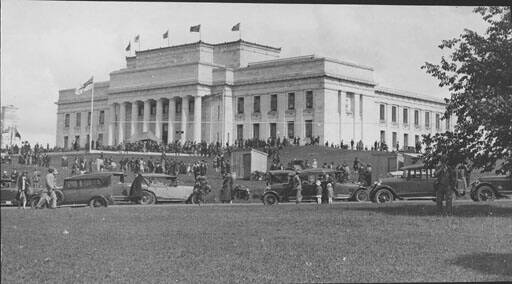
Dominating Auckland Domain is the Auckland War Memorial Museum and Cenotaph. The large neo-Greek style museum building was opened in 1929 with the rear portion added in the 1960s, with a major renovation and extension in the mid-2000s adding a dome to the south end.
In 1940, to commemorate the founding of Auckland 100 years earlier, a new road was planned for the Domain. “Centennial Drive” was surveyed and trees were planted along its length, but it was never formed as a road; it is now a walkway between the duck ponds and Stanley Street.
An 18,500 cubic meter / 4 million gallon water reservoir was constructed in 1952, buried in the field at the high point to the immediate south of Auckland Museum. The reservoir is still in use maintaining the water supply into Auckland’s CBD.
In 1970, a sensory garden for the blind was established at the eastern end of the Domain by the Tamaki Lions Club and Council.
In 2005, a monument for the Auckland Regiment was installed south of the central cone.
Events
The Domain has also hosted many of New Zealand’s largest outdoor events. Such use has a long history, from balloon ascents during the Edwardian period, to the 1953 Royal Tour of Elizabeth II, to papal visits, and various sports events.
Some of the largest annual events are “Christmas in the Park”, which in the past has drawn more than 200,000 spectators, and other popular recurring events including the “Symphony under the Stars” and the “Teddybears Picnic”.
The 2005 Red Bull Trolley Grand Prix was held using Domain Drive as the racecourse.
 Angel
Angel 