Task:
Write 300 words to situate your ideas. This writing should be supported by maps/diagrams to contextualise your thinking around your project. Questions to consider:
– Did something come out of the documentation that might drive these proposals?
– Any hunches, intuitions, gravitational pulls?
– Has something emerged from the documentation of others, that might shift the direction of the project?
– Do you want to extend social activity that occurs, or introduce?
– Are there connections between these ideas and the materials in your Inventory?
Laying out the Map – Setting my own Parameters
From all my past studio work, they have all been driven from my interests, experiences and curiosity. Thankfully we are given enough time to explore and reflect on all our work using other people’s thoughts/ advice. Personally, I think giving other people’s advice/ thoughts is another way for us designers to grow and expand our knowledge on certain things, such as how other designers approach things.
During my documentation I was surprised that I was able to document a lot of things whether it be useful or not. As one of accustomed students who uses the place, I have observed a few pros and cons about the place I haven’t thought of or come about before my observation/ documentation, things like the atmosphere of the social space changes between daylight and nighttime (more movement and sounds during daylight compared to nighttime).
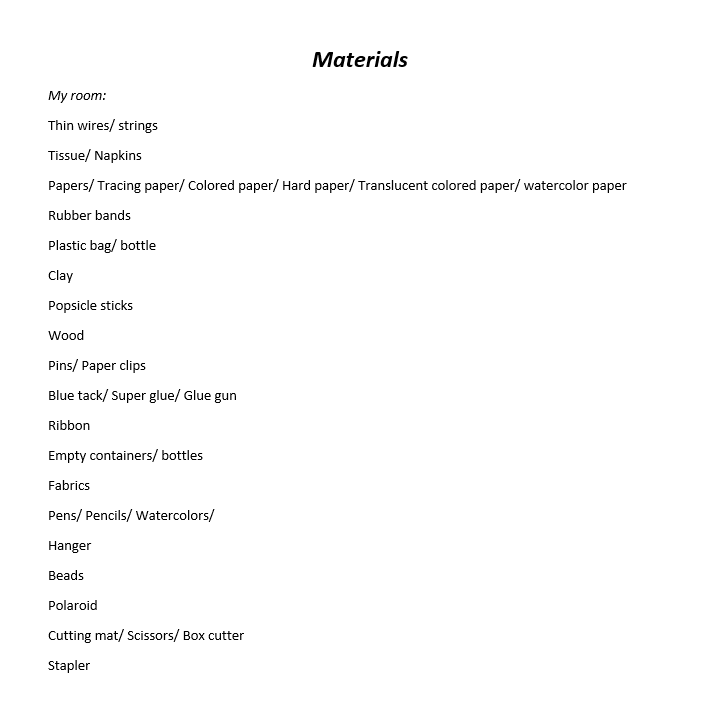
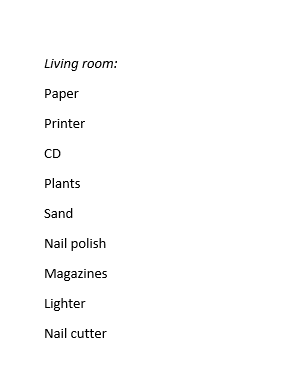
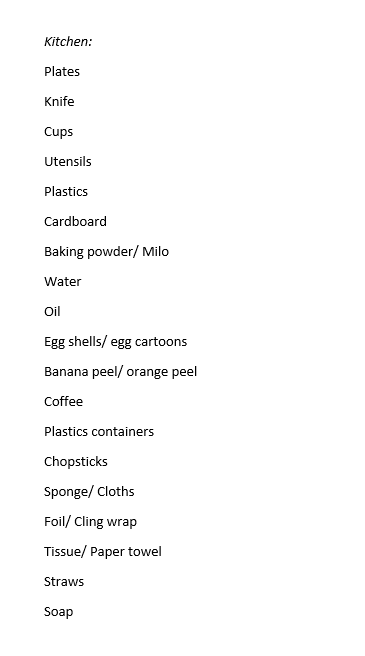
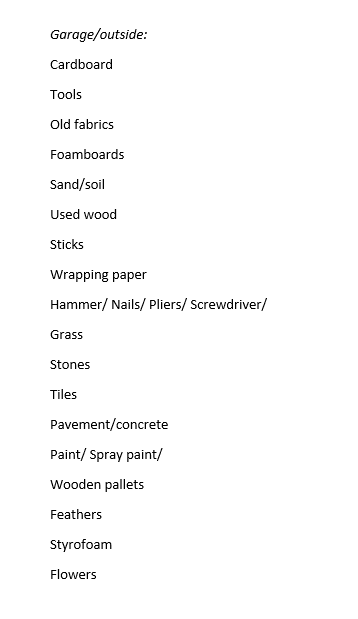
Nonetheless for my proposal I will be categorizing the correlation of private and public, in addition I also want to extend social activity between accustomed students within the space. The main drive for my proposal is making use of what I have at home, correlating to working outside of my house and being limited with what I have in my bag.
In reflection from my previous studio work, I would still like to restrict myself from using my interests in minimalism and explore other design precedents there are.
Proposals
Herea re two key questions to help you in setting out your proposals:
What is it that you are proposing? (Physical, actually)
Part of a poposal is direct and clear written description of what will actually happen. This should/could include information regarding location, timing, duratiom, size, audience, material, quantity, etc. The emphasis or inclusion of these types of information will differ depending on what is being proposed. Something to remember is: will this be easily graspable, given the information I have provided?
Why are you proposing it? (conceptually, contextually)
Another part of a proposal is a written outline of the relevant conceptual or contextual information. What has informed your developement of this proposal? You could think of this as the ‘why’ of the project: why are you proposing this? Why here/now/in this way/with this audience? The answer to this question should draw on how you as an individual designer have been thinking about the site and its social relations.
What will help the reader/viewer really ‘get it’?
A proposal often relies on a constellation of materials to help the reader/viewer from a picture in their mind, understand an atmosphere or feeling, or grasp conceptual/contextual aims. In this case, you should be using both written and visual elements in your proposals. Depending on what is being planned, some proposals mat require site plans, or durational schedules. What about photo collages, drawings, mock-ups,maquettes? How can you use a carefully edited constellation of visual and written material to help the reader/viewer ‘get’ it easily?
What is the visual,aesthetic language of the proposal?
Proposals are not ‘finished’ projects (or even finished pitches for projects), and so can speak through the language this ‘unfinishedness’ to demonstrate an openess or flexibility. Consider how the use of pencil, looser lines, iterative drawings, visible tape, scanned texture, hardwriting might be able to speak in this way.
You might like to think of this like the proposal is leaving open spaces for the reader/viewer’s imagination, by employing a visual language of provisionality.
Like minded
Allan Kaprow
FLUIDS. A HAPPENING BY ALLAN KAPROW
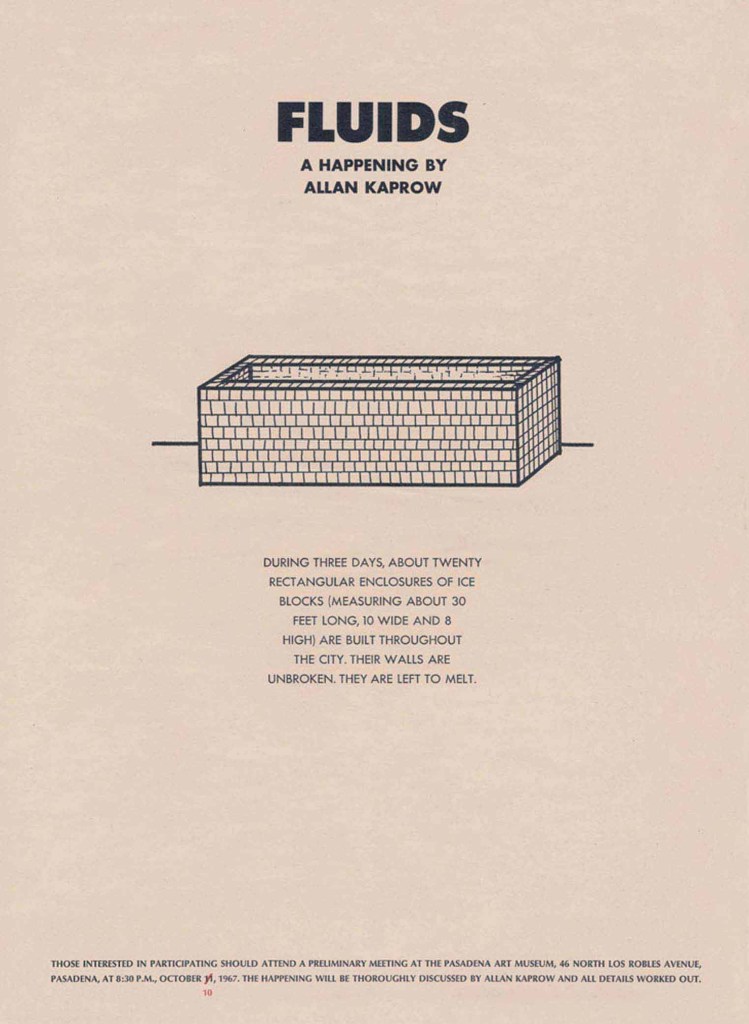
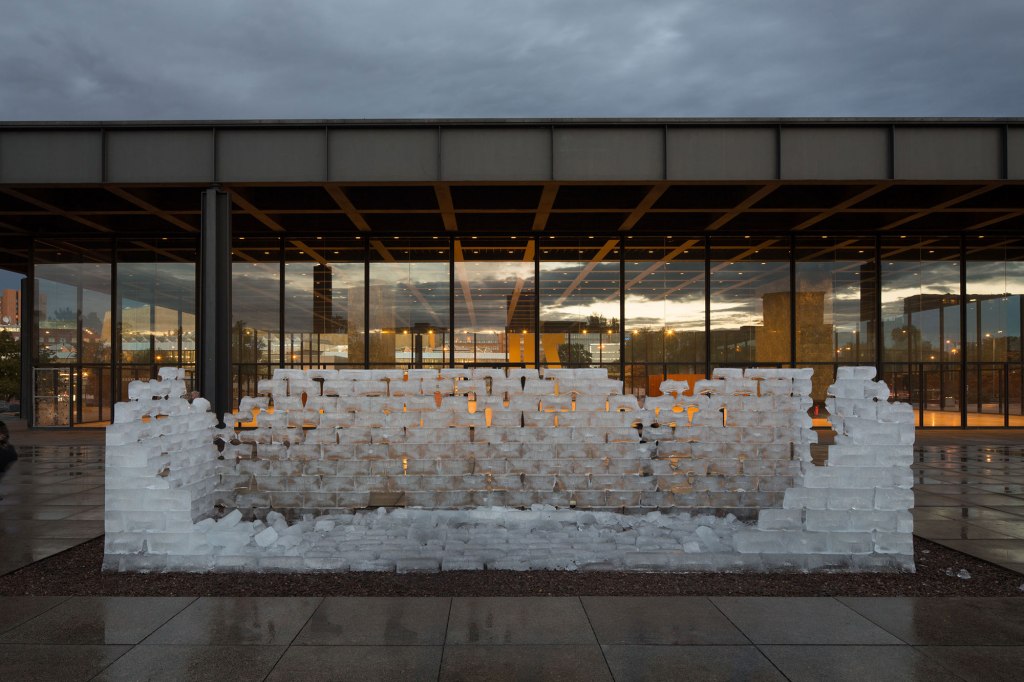
As part of the collaborative project STADT/BILD (Image of a City), the Nationalgalerie is showing Fluids. A Happening by Allan Kaprow, 1967/2015 in the Berlin urban space. Allan Kaprow (1927 – 2006) is one of the most influential and at the same time least known artists of the second half of the 20th century. He coined the term “happening”, but his own work was largely forgotten because of the object-less nature of his artistic practice. Fluids was first created October 1967 at various public locations in California. With the assistance of volunteers, Kaprow built several structures measuring around 9 m long, 3 m wide and 2.4 m high, using ice blocks as his material. Once in place, these ice structures were simply left to melt. In its temporality and materiality, the work represents a challenge to the traditional understanding of art in public space.
What endures of Fluids and the happenings of the 1950s and 1960s? How do we approach this happening retrospectively, nine years after the artist’s death? Kaprow had his own answer: “While there was an initial version of Fluids, there isn’t an original or permanent work. Rather, there is an idea to do something and a physical trace of that idea. … Fluids continues and its reinventions further multiply its meanings.”
Five “reinventions” of Fluids will be taking place during Berlin Art Week. The Nationalgalerie has invited Berlin-based artists OLIVIER GUESSELÉ-GARAI, ASSAF GRUBER, ANTJE MAJEWSKI, AGNIESZKA POLSKA and JULIANE SOLMSDORF; AHMET ÖĞÜT; ALEXANDRA PIRICI and the artist’s group STADT IM REGAL to create their own contemporary responses to Allan Kaprow’s happening.
In addition to these four artistic interpretations, the Nationalgalerie is organizing a reconstruction of the historical action.
HISTORICAL VERSION
The institutional version remains faithful to Allan Kaprow’s original score, which was featured on the original poster. Meant both to announce the event and to recruit participants, it reads: “During three days, about twenty rectangular enclosures of ice blocks (measuring about 30 feet long, 10 wide and 8 high) are built throughout the city. Their walls are unbroken. They are left to melt.” In small print at the bottom of the poster, a meeting time and place is mentioned for those interested. This call for volunteers and their participation, the specification of the material, the dimensions of the ice sculpture, as well as the order in which the process is to be completed will be maintained in this new version of Fluids. On September 15, 2015, the ice sculpture will be erected on the terrace of the Neue Nationalgalerie. Prior to the happening, discussions and a preparatory meeting of the participants regarding logistics and organization have been held illustrating the key role of this for the overall work.
In October 1967, both the Neue Nationalgalerie, which was designed by Mies van der Rohe (and opened in the fall of 1968), and Fluids were in a state of construction. This new happening will be presented on the museum’s terrace, which is both a public and institutional space, free of charge and accessible at any time. Notably, it will take place next to Alexander Calder’s and Richard Serra’s monumental steel and iron sculptures. Unlike traditional public art, this ice structure’s sculptural form, which is reminiscent of Minimalism’s geometric aesthetics, is constantly changing, moving, melting, and vanishing.
Participants of the happening: KAROLINE BAUMANN, SIMON BECKMANN, FLORIAN FLUG, JESSI HUNDT, ERNST FRIEDRICH JÜNGER, CLAIRE LAUDE, ADRIAN LOHMÜLLER, LUCAS ODAHARA, KETEVAN ORTOIDZE, BERENIKA PARTUM, CARMEN REINA, FRANZISKA SANDER, SANTIAGO DA SILVA, SEBASTIAN STAHL, ANNA STUHLMACHER, SOPHIE THORAK
From the Nationalgalerie: LUTZ BERTRAM and OLIVER LEHMANN (art handlers), ULRIKE GAST (registrar), TORSTEN NEITZEL (depot manager),UDO KITTELMANN and LISA MAREI SCHMIDT (curators), LEAH HECKEL and CHARLOTTE SARRAZIN (curatorial assistants)
With generous support from Museum&Location, Bundesamt für Bauwesen und Raumordnung and KVL Bauconsult GmbH.
 Angel
Angel 