Building an indoor pool key factors (info can be found at dantherm.com)
Building an indoor swimming pool is often a rather large investment, and it is important to protect the pool building properly.
Far too many private and public indoor swimming pools have been destroyed because the inventory, walls and building structures were eaten away by mould, rot and corrosion – because an adequate dehumidifying system was never installed.
Installing a dehumidifier is crucial to handling the large volumes of water constantly evaporating from the surface of a pool, and from the damp tiles around the pool. Several thousand litres of water can evaporate from a swimming pool in a single day.
Choosing the right dehumidifier is a complex process, and there are a number of factors to take into consideration. In this article we list the most important ones to give you an overview of the process.
Ensure the chemistry of the water is correct:
The first step is not about the dehumidifier itself, but about creating an environment in the pool room, that is both comfortable for users and not too aggressive on the interior.
Insufficiently treated water results in poor hygiene, while water that has been excessively treated results in gases in the air that contain chlorine, which can irritate the eyes and cause breathing difficulties.
At the same time, the incorrect composition of chemical ingredients in the water could quickly destroy the inventory, including the dehumidifier and other equipment that have been installed to process the air.
Choose the right type of dehumidifier:
Basically, an indoor swimming pool can be dehumidified in two ways: by using condense dehumidifiers or by using ventilation dehumidifiers.
In small pools and spas there is rarely a need for large volumes of outdoor air. In these cases, a condense dehumidifier is often chosen, because it is simple to use and the investment is small.
In medium large pools, private pools or hotels, the choice will be between a condense dehumidifier and a ventilation dehumidifier, depending on several factors: requirements for the volume of outdoor air, level of comfort and the size of the budget.
If there is a strong requirement for the volume of outdoor air and comfort, and the budget is large enough, the choice will tend to favour a ventilation dehumidifier.
In large public swimming pools, because of the number of users, the requirement for the volume of outdoor air will often mean that a ventilation dehumidifier is the best solution.
Using a dehumedifier to manage temperature:
In addition to dehumidification, the dehumidifier can also be used to regulate air and pool water temperatures. However, the pool water can only be warmed by a unit that has a built-in cooling circuit.
Depending on which dehumidifier has been chosen, there are different options available for temperature regulation. A heating coil is the most popular way to control the temperature.
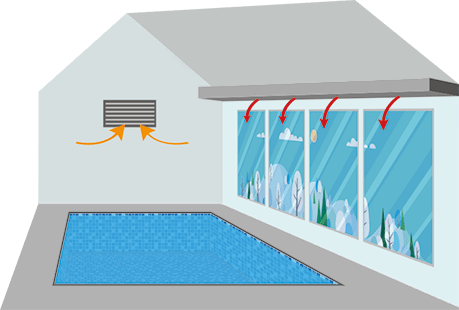
When summer sunlight shines through the windows, the swimming pool often exceeds the desired room temperature. With a ventilation dehumidifier you will have the possibility of utilizing free cooling. With free cooling, the cooler outdoor air is drawn past an exchanger through a by-pass, so that the outdoor air is not warmed.
In some countries, free cooling is not sufficient, and in those cases it is possible to build a heat pump in a reversible cooling unit using a 4-way valve. In this case the outdoor air is drawn across a cold coil and cooled down.
Determining operating conditions:
There are a number of factors to consider when determining operating conditions for a dehumidfier. The five most important are:
- Room temperature
- Normally recommended to be set 2 °C higher than the water temperature
- Water temperature – typical values below
- Private pools and hotels: 26-30 °C
- Public swimming pools: 26-28 °C
- Competition swimming: 24-27 °C
- Therapy baths: 30-36 °C
- Spa: 36-40 °C
- The relative humidity of the air
- Setpoint typically around 50 %RH during winter and up to 60 %RH in the summer
- Water content in the outdoor air
- VDI Northern European Standard is 9 g water/kg air
- Other characteristics of the outdoor air
Calculating the humidity load:
There are three factors that must be taken into consideration when calculating the humidity load from a swimming pool.
- The evaporation from the pool – contributes positively to the humidity load
- Bystanders and users – contribute positively to the humidity load
- Outdoor air – normally contributes negatively to the humidity load
The calculation of the evaporation from the pool can be carried out in accordance with different formulas. At Dantherm, we use the German guideline VDI 2089, which is the normal standard in Europe.
Air circulation and distribution: Air circulation in a pool room is important, because air that moves does not condense as easily as stationary air.
The air circulation is defined as the total number of times the volume of air circulates in the room within an hour. The air should normally circulate 3–10 times every hour depending on for example the insulation of the building. Poorly insulated buildings will often have problems with cold surfaces that require a higher level of air circulation to avoid condensation.
Distributing the air in the pool room also plays an important role. If you add outdoor air to the room, then exhaust air must also be extracted from the room. Otherwise overpressure will occur in the room, which can lead to condensation in the walls and chlorine odour in the adjacent areas.
To ensure negative pressure the volume of exhaust air + extract air should be approximately 10 % higher than the volume of supply air.
Below shows were my vents can be found in my design:
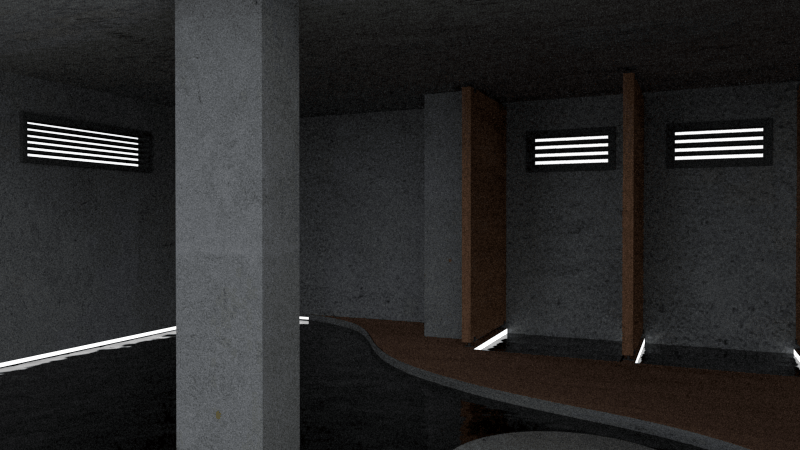
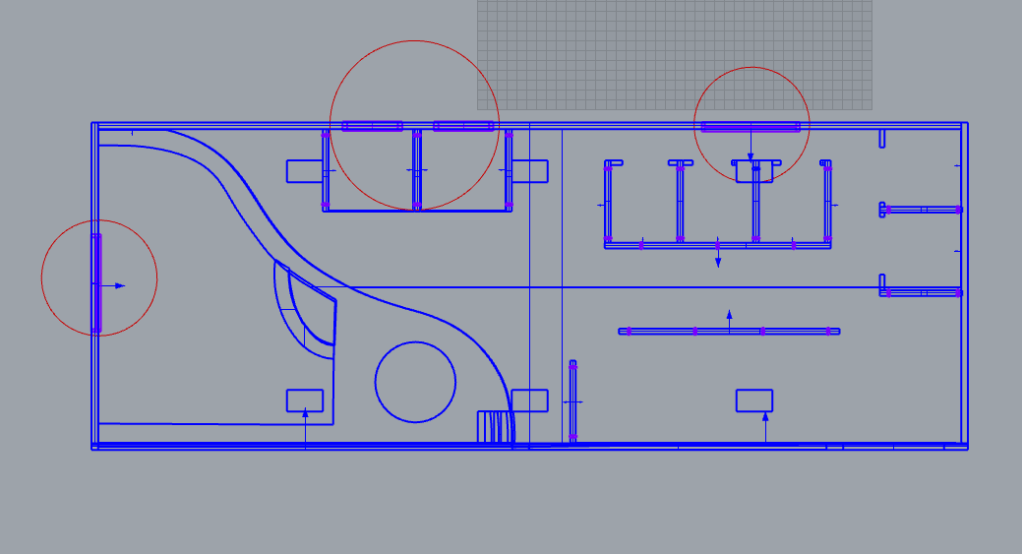
1 above the major bathing area, 1 for each complementary bathig area and one near the toilets/changing rooms/showers
 Angel
Angel 