Spatial Design Studio
Today in class we were introduced to our new project for our semester two paper Spatial Design Studio 1. This is a semester long project with formative submission half way through.
The projects requires us to come up with a bath house proposal for the current basement space of the decommissioned Dadley building. Across the road from WSA located on 8 mount street.
The Dadley Foundation building, currently AUT’s WW building, was a hospital and live-in care facility for disabled children.
Research : (History)
Ancient Roman Bathing:
Bathing played a major part in ancient Roman culture and society. It was one of the most common daily activities in Roman culture, and was practiced across a wide variety of social classes.Bathing played
Though many contemporary cultures see bathing as a very private activity conducted in the home, bathing in Rome was a communal activity. While the extremely wealthy could afford bathing facilities in their homes, most people bathed in the communal bathsthermae. In some ways, these resembled modern-day spas. The Romans raised bathing to a high art as they socialized in these communal baths.
Bathing in Greek and Romain times:
Some of the earliest descriptions of western bathing practices came from Greece. The Greeks began bathing regimens that formed the foundation for modern spa procedures. These Aegean people utilized small bathtubs, wash basins, and foot baths for personal cleaniness.
Greek mythology specified that certain natural springs or tidal pools were blessed by the gods to cure disease. Around these sacred pools, Greeks established bathing facilities for those desiring healing. Supplicants left offerings to the gods for healing at these sites and bathed themselves in hopes of a cure. The Spartans developed a primitive steam bath. At Serangeum, an early Greek balneum (bathhouse, loosely translated), bathing chambers were cut into the hillsidu into the rock above the chambers held bathers’ clothing. One of the bathing chambers had a decorative mosaic floor depicting a driver and chariot pulled by four horses, a woman followed by two dogs, and a dolphin below. Thus the early Greeks used natural features, but expanded them and added their own amenities, such as decorations and shelves. During later Greek civilization, bathhouses were often built in conjunction with athletic fields.
The Romans emulated many of the Greeks’ bathing practices, and surpassed them in the size of their baths. As in Greece, the Roman bath became a focal center for social and recreational activity. With the expansion of the Roman Empire, the idea of the public bath spread to all parts of the Mediterranean and into regions of Europe and North Africa.
Republican bathhouses often had separate bathing facilities for women and men, but by the 1st century AD mixed bathing was common.
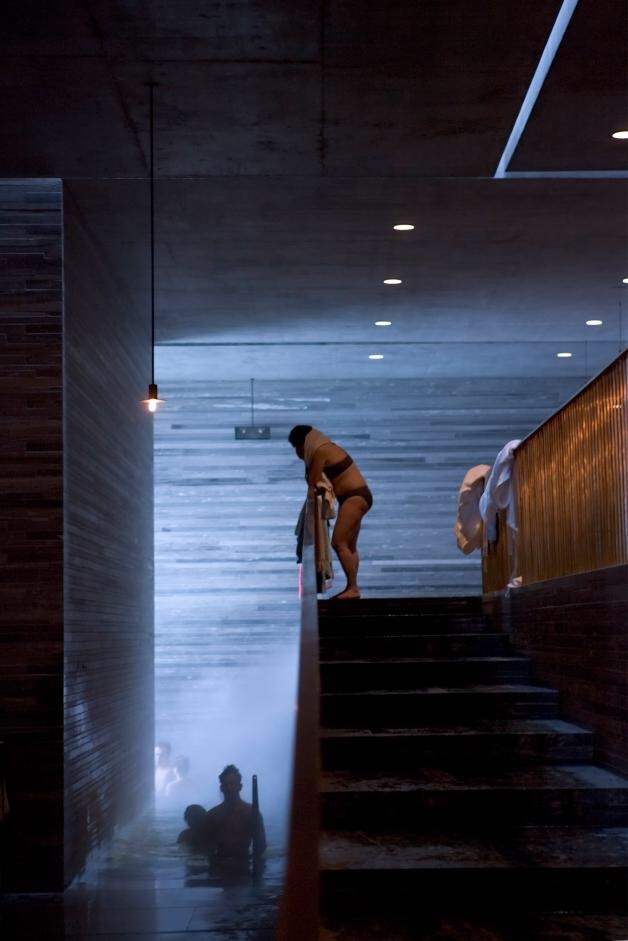
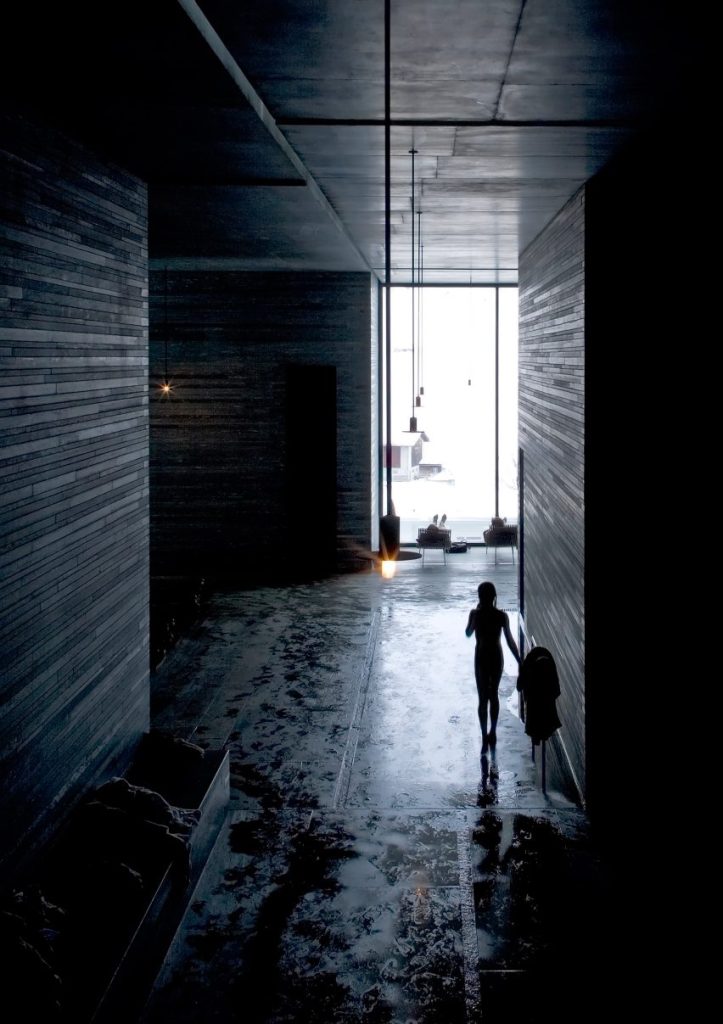
Thermal baths at Vals designed by Peter Zumthor in 1996
Hot and cold
Light and shadow
His idea was to create a form of cave or quarry like structure. Working with the natural surroundings the bath rooms lay below a grass roof structure half buried into the hillside. The Therme Vals is built from layer upon layer of locally quarried Valser Quarzite slabs. This stone became the driving inspiration for the design, and is used with great dignity and respect. His idea was to create a form of cave or quarry like structure.
 Angel
Angel 